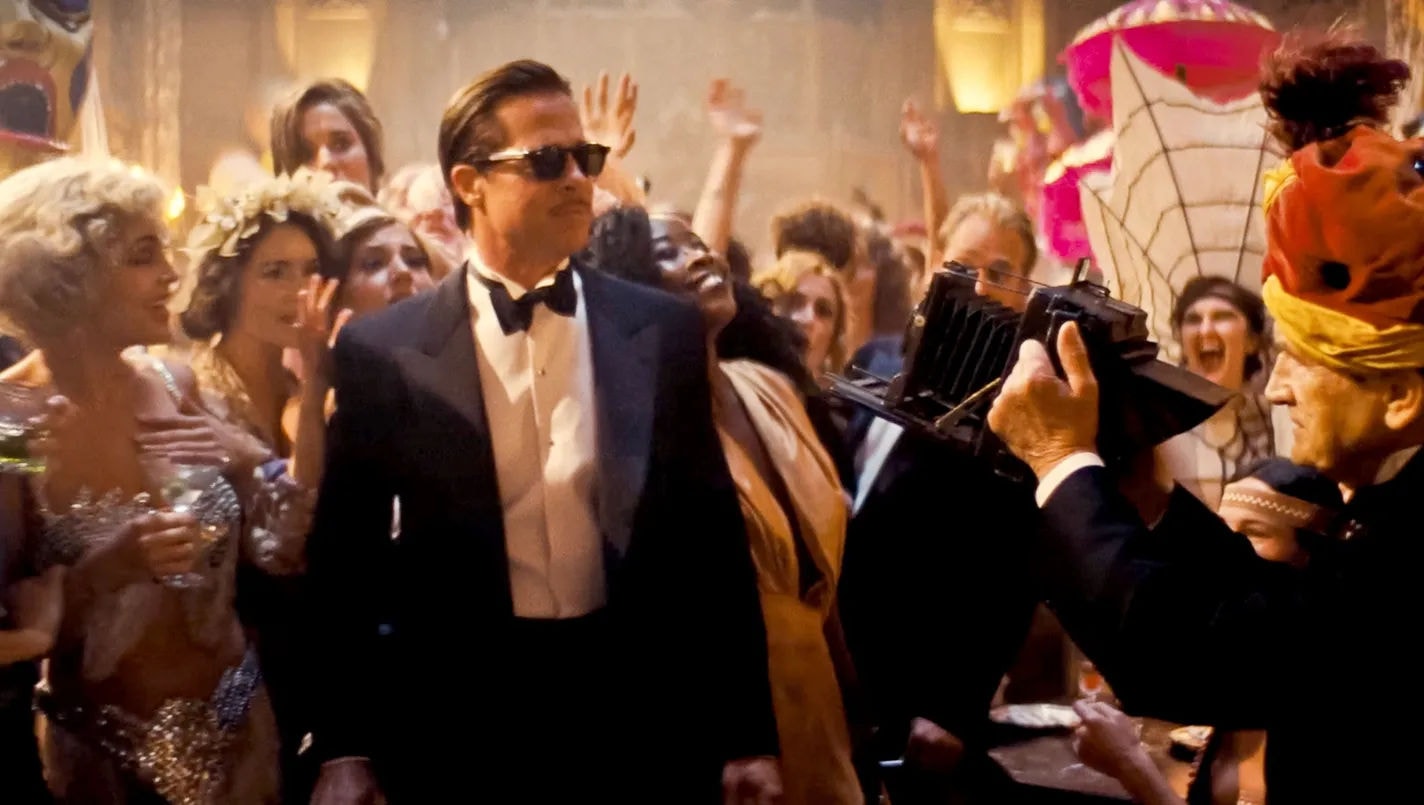
For the most part, directors fly under the radar, working in the background, oftentimes missing out on any of the promotional junkets that actors are subjected to. There are, however, a few directors that manage to slip into the spotlight, and Damien Chazelle fits that description. Like clockwork, each film of his is released and immediately given awards consideration, and crowds get excited-at least they used to. For me, Babylon marked the first Chazelle picture I watched during its theatrical run, and I was solo.
Babylon takes place during the 1930s, an era in Hollywood marred by drugs, violence, excess, and almost any other grimy undertone imaginable. Manny, played by Diego Calva, longs to be a part of something larger than him and begins his career in the transitioning film industry. Charting the film industry’s shift from silent films to “talkies,” Babylon takes audiences along for a ride that shows a different side of Hollywood — one that Hollywood would like to be forgotten.
The film has so much going on, and that isn’t a good thing. The excess that the film touts feels like a detractor more than a worthy inclusion. A sense of sensory overload begins to creep in during just about every sequence — especially the lavish ones. Being that this is technically an “epic,” I was prepared for the longer-than-usual runtime that accompanied this film, but this truly felt like one of the longest films ever produced. The pacing isn’t necessarily all over the place, but staggeringly slow for 90% of it.
The performances, as a result, become lost in the excess, with every single character falling into the background of their own making. In so doing, the stakes feel nonexistent for just about everyone. Not a single person is particularly likable-just annoying. Manny, the film’s main character, is decent enough and seems like a good guy, but there isn’t anything connecting me to him. I didn’t resonate with him early enough in the film, and my relationship never matured throughout the film. Nellie, played by Robbie, was not my favorite character in the film despite her significance to the story. She dominated every scene she was in, which worked in some instances and didn’t in others. And Jack Conrad, played by Pitt, was fine, but again nothing too memorable. I suppose I was most interested in him as a character, but that isn’t really saying much. Sadly, I just didn’t mesh with any of these characters. I wish I did.
The film truly shines in the larger sequences, often including some catchy musical numbers, despite how excessive they are. The camera movement is intoxicating as it flies throughout the confined area, barely missing performers as they act out their scenes. Seeing it on the big screen was an absolute feast on the eyes, and I felt like a kid discovering movies all over again. The music that accompanies these sequences is also top-notch. Everything is catchy, motivated, and matches the style and vibe of the scene. Chazelle truly is a master of these kinds of sequences.
Things begin to fall all off the rails when it becomes clear that it is many things, and a historic retelling is not one of them. I was expecting, and hoping, for the film to be primarily historically accurate, telling a lesser-known story about an important shift in Hollywood history. Instead, the film is more of a critique of Hollywood and the power those within it have. A rather bleak comment on the status of the industry, Chazelle’s picture feels much more directed at the system than anything else. Not a big deal for some, but it was for me.
From an editing standpoint, nothing really stood out to me, save for the final twenty minutes or so. It isn’t until those final twenty minutes that this film finally begins to feel like a Damien Chazelle film. There is so much more emotion, restraint, and compassion behind each movement and action. The feelings that Manny is having are loud, and for the first time, I can connect with him. The sequence that concludes the film continues to be one of the few shining moments of the entire 189 minutes. The rest of the film struggles to handle the ambition well. There is a lot going on, and the film never makes it feel slow or small, only allowing for a few moments of rest before something else happens.
Unfortunately for me, Damien Chazelle’s latest film didn’t live up to the hype I built up in my head. The film, for most of its runtime, is a mess of bodies, liquids, powders, and music that quickly begins to feel like madness. It isn’t until the film lets off the gas for a moment that things begin to change, but that doesn’t happen enough. As a result, Babylon feels far more earth-shattering than it actually is, with very few moments that feel authentic and sensible. And even though the last twenty minutes of the film are truly exceptional, I just can’t justify the terms of that deal.
From Letterboxd: Less a retelling and more a critique, Chazelle’s latest picture is nothing if not ambitious. With catchy musical numbers and exceptional set pieces, Babylon feels far more earth-shattering than it is. Instead, the film is messy and bombastic, with only a few glimmers of hope. In a film that boasts a nearly three-hour runtime, the best part of the entire film comes in the last twenty minutes. And even though it is a fantastic series of minutes, those are terms I just can’t sign up for.
Subject to change.