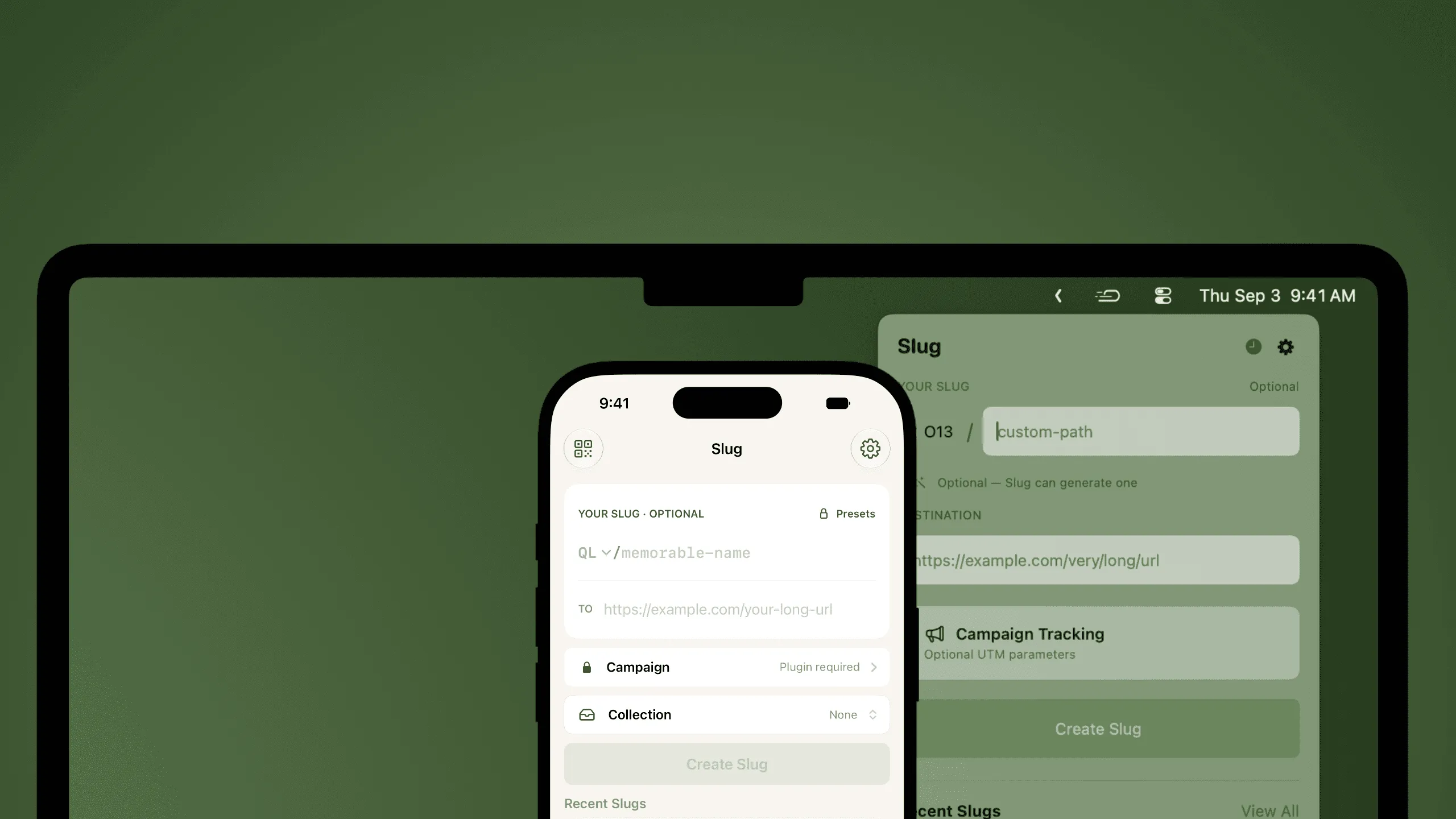
Let me preface this article with the following: this isn't going to be an in-depth article talking about the specific changes coming to Quick.Link/Slug. It's instead going to talk about why I decided to rebrand in the first place, and why Slug was the choice that made the most since.
Quick.Link has continued to be a pleasant suprise in my life. I've been amazed at the recent downloads and, seemingly, successful experiences. Despite this sudden surge, I've long questioned the viability of Quick.Link. For a long time, I thought the app was too niche, but I think the problem was more of a discoverability one. The app felt too bland, and the name? Well, the name was too generic. Something needed to change, and the most obvious thing, was the name.
Becoming Slug
It actually took some time before landing on Slug for the new name. Initially, I was very intent on continuing to have "link" somewhere in the name. I considered names like "Link'd," which was a subtle nod to my first short film, SPOOK'D, "Relay," which felt like I'd be needlessly competing with Reddit, and my second favorite, "Alias," which felt straight out of a sci-fi movie. Ultimately, however, Slug felt the most approachable for newcomers and experienced users alike. Slug also allowed a unique possibility to incoporate a mascot, which I try to do in all of my apps (Bit Buddy, Pigzel (coming soon 👀...?)).
Once I decided on the name, I went to one of my process staples, Coolors.co and tried to get some inspriation for the new color palette. It took a while, but I eventually found a nice forest green that felt deeply polished. With the help of Apple's Icon Composer application, I was able to create a nice gradient, which I then copied to the app's asset catalogue. From there, it was just a matter of replacing Quick.Link's colors, which was as easy as rebuilding the app. The rest of the design, however...
Finding the balance between useful and useless redesign was extremely difficult when designing Slugs new interface. On the one hand, everything needed to be redesigned to match the new design of Slug, but on the other, I needed to preserve the ease-of-use that Quick.Link had (and users expect). It became a selective process, redesigning chunks at a time to ensure that things still felt efficient and connected. I think I found a good balance in the end, but only time (and users) will tell.
The rest of this process would be time consuming in the pre-AI era, but this is one area I've found it to excel in no matter the project: renaming. I gave the project to Codex and asked it to replace the term "Quick.Link" with the term "Slug," and provided additional context. In a matter of seconds, all mention of Quick.Link was swiftly erased in favor of Slug, and the redesign/rebrand was complete.
The Finishing Touches
The rest of the time went into bug fixes and other small polishings, including updating the widgets to match the new design, as well as several bug fixes. I also tried to improve the connection logic between Slug and YOURLS, hopefully resulting in fewer errors during onboarding.
All told, this is the largest update for Quick.Link/Slug, but the more I think about it, it's the largest update I've ever released. For an app that felt all but dead a few months ago, that's pretty nuts.
Slug is Available Now
This transformation took a little longer than I expected. Hell, my original plan was to ship a small bug fixes update! But the more I worked on it, the more I felt a change was needed. Something major to shake things up. This update certainly does that (and then some!).
This is a substantial shift for Quick.Link/Slug, so if there are any issues, please use the contact form in the Settings panel of the app. It's the easiest, and most direct, way of receiving support. Thank you so much for downloading and using Quick.Link, now Slug. And, as always, happy linking!