
At the center of Flyby is Fly Score: a quick assessment of current or forecast flight conditions. It is designed to answer the first question I have before a flight: “How are things looking?” All while making it easy to understand what is behind the answer. Creating Flyby's Fly Score was as much of a learning experience as the rest of the app, and the final form it's taken for release is something far different from the original concept.
From Concept to Confidence
So much of Flyby's concept relies on the Fly Score, so the concept for the Fly Score was very important to get right. From the start, it was clear that the score needed to consider a lot of data. As you'd expect, metrics like weather conditions, visibility, and wind-speed are all taken into account, but that only helped Flyby get halfway there. The rest of the work, ultimately, was more involved.
After many iterations, it became clear that the only way Fly Score could work was if it was malleable. It needed to adjust and adapt to each pilot's individual preferences and equipment, while also honoring the weather conditions and other metrics available throughout the app. Not only that, it also needed to be flexible enough to account for changes, without ever over-stating its authority or confidence, which was the final trick into locking Fly Score into shape.
Never once was it the goal for Flyby or Fly Score to definitively communicate whether or not flying was authorized. It's merely designed to provide additional context to the pilot in a glanceable way. The best way, we found, to communicate this was to, well, communicate it! Seriously, whenever possible, Flyby clearly communicates that it's recommendations are solely that: recommendations. It took a little bit of extra work, but it helped ease my and my brother's mind a lot when working on it.
"What Shapes This Score"
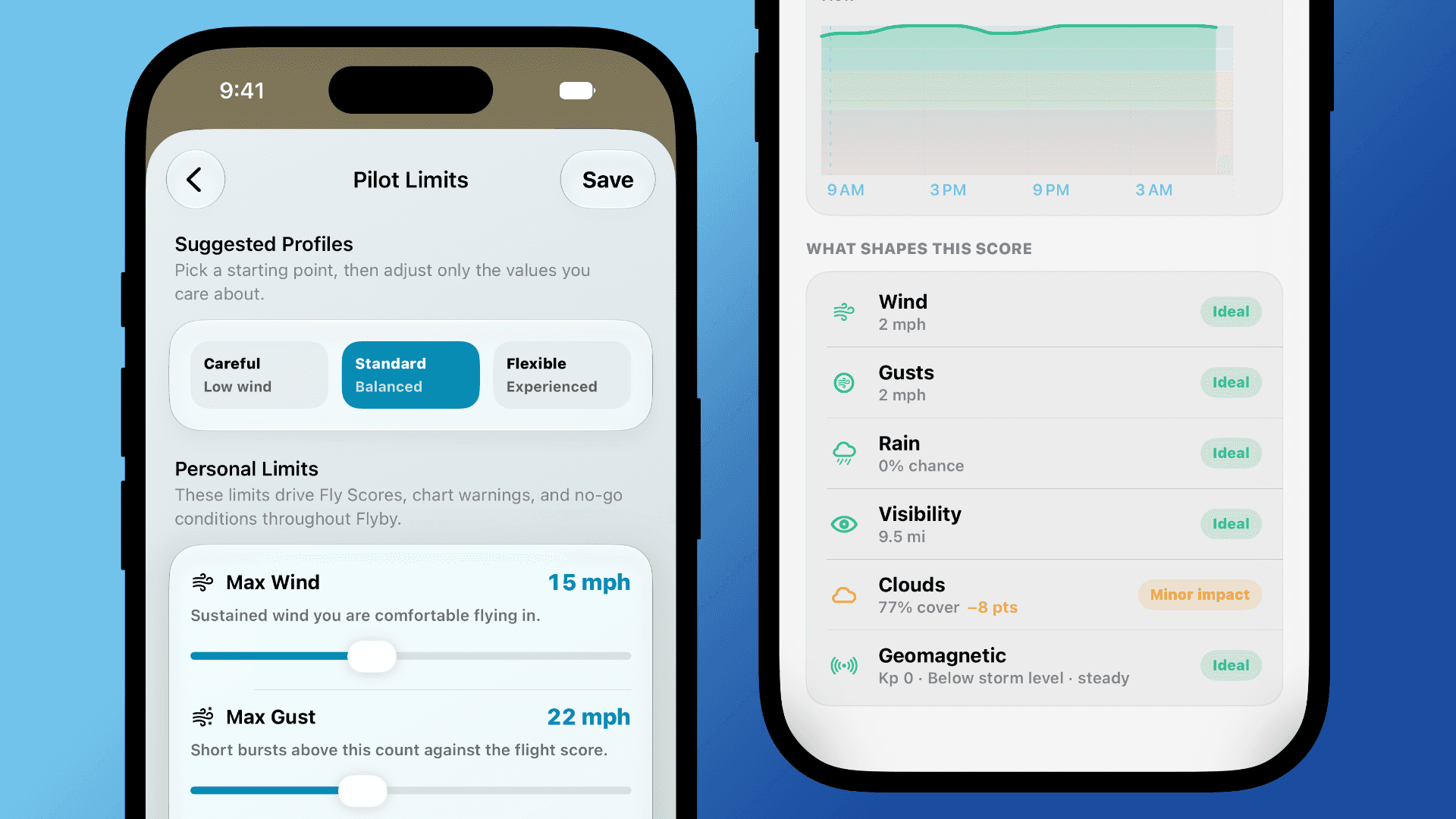
Once I felt confident in Fly Score and the approach in-app, the next consideration was whether or not Flyby "showed its work." This is a concept/ideology that I've found myself particularly attracted to since starting app development again. I've never liked apps that present "magic numbers" without explaining how the number was calculated. So, Flyby does!
This section of the Fly Score Sheet was a real labor of love. I love data (hence, why Flyby exists), but more than that, I love following how the data interacts and flows together. This section is incredibly basic, but that's exactly what it needs to be. Pilots can see how their Fly Score was calculated and exactly which metrics are impacting them, and by how much. It turns the Fly Score Sheet from a mysterious presence into something tangible and real, in a way, and I like that.
Designing for Trust
Fly Score is intentionally opinionated. Without interpretation, Flyby would be another collection of weather measurements. But that opinion is constrained by visible reasons, configurable limits, explicit uncertainty, and a clear boundary around what the app can claim.
When Flyby says conditions look excellent, I want that to be genuinely useful. I also want the pilot to be able to tap deeper, understand exactly why, check the remaining factors that no app can verify, and make the final decision themselves.
In the next article, we'll take a look at Flyby and the various technologies it employs to creative a wholly native experience for iPhone and iPad users, while maintaining compatibility across macOS and visionOS. Plus, we'll explore possible extensions into other areas of Apple's ecosystem 👀.
Until next time, Nick out.